Show summary Hide summary
- Service restart: dates, trains and first runs
- Route, distance and key stops
- How much faster is the new service?
- Border control: what travellers should expect
- Onboard experience and practical tips
- Technical upgrades behind the speed gains
- Top reasons to visit Budapest in 2026
- Why Belgrade is worth the trip
- Planning tools and travel reminders
The long-awaited direct rail link between Budapest and Belgrade is poised to reopen, bringing faster cross-border travel and fresh tourism opportunities between Hungary and Serbia. Freight trains will test the route first, while passenger services depend on final safety checks on the Hungarian stretch.
Service restart: dates, trains and first runs
Freight traffic will resume on February 27, 2026, to ensure the line is fully operational. Passenger services are slated to return in March 2026, pending final Hungarian safety approvals.
Sophia Laforteza of Katseye announces hiatus: comes months after Manon Bannerman’s exit
Delta to return to Tokyo Narita hub in 2027: 7-year comeback
- Initial plan: about six round-trips daily.
- Main departure: Budapest Keleti station with roughly two-hour intervals.
- Freight first, then passenger trains after signalling and control tests.
Route, distance and key stops
The reopened corridor covers around 217 miles in total. About 103 miles lie inside Hungary. The upgraded route shortens travel time and improves capacity.
Likely station sequence on the route
- Budapest Keleti (Hungary)
- Kiskunhalas (Hungary)
- Kelebia (Hungary) — border crossing
- Subotica (Serbia)
- Novi Sad (Serbia)
- Belgrade Center (Serbia)
How much faster is the new service?
The modernised line is expected to cover Budapest–Belgrade in about 3 hours 15 minutes. That is a large cut from older services, which could take more than eight hours when border delays were included.
The Hungarian section has been rebuilt to double track and supports speeds nearing 99.4 mph (160 km/h). This upgrade accounts for most of the time savings.
Border control: what travellers should expect
Hungary is in Schengen; Serbia is not. Border formalities will therefore remain part of the journey.
- Checks will take place at Kelebia under a joint Hungarian–Serbian procedure.
- Authorities plan a single, combined stop for passport and customs control.
- Officials expect processing to take no more than about 30 minutes.
US citizens currently do not need a visa for short stays to Hungary or Serbia. However, a Schengen travel authorization (ETIAS or similar) is expected to be required for many travelers from late 2026. Check official sources before you travel.
Onboard experience and practical tips
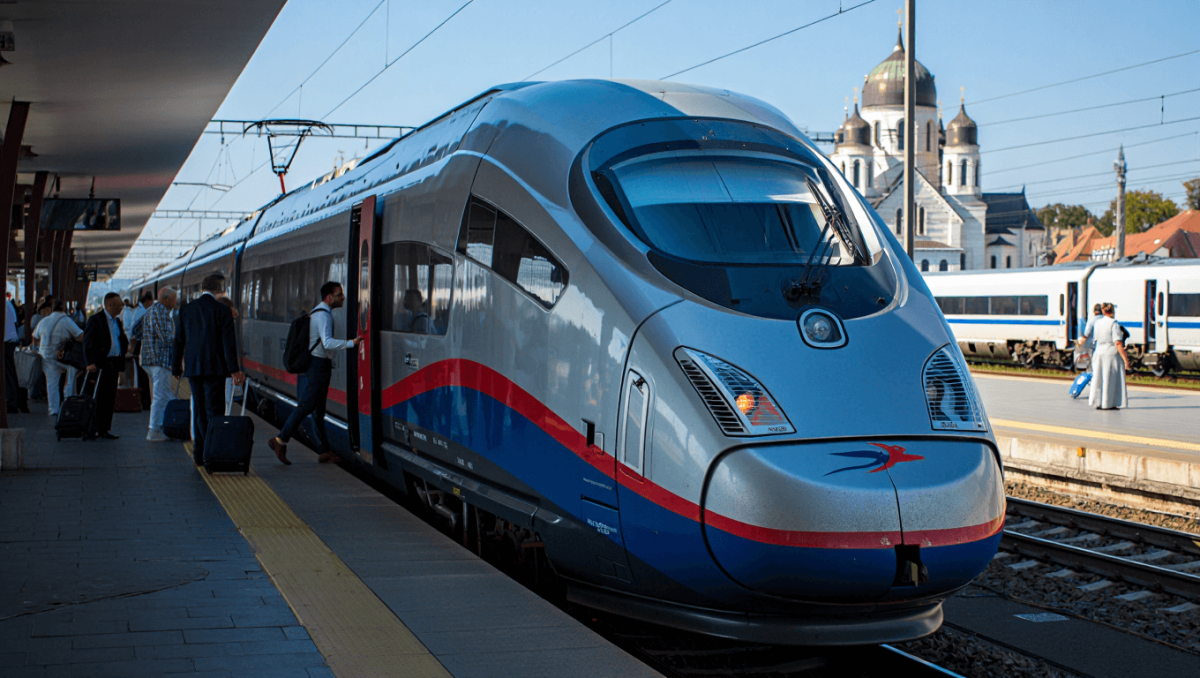
Expect modern rolling stock on the upgraded line. Trains should offer comfortable seating and standard onboard amenities.
- Buy tickets in advance to secure seats on peak departures.
- Carry valid travel documents and, if applicable, your upcoming Schengen travel permit.
- Pack light for a short international trip and allow time for the Kelebia stop.
Technical upgrades behind the speed gains
Engineers rebuilt large parts of the corridor. The main improvements include double-tracking in Hungary, renewed signalling, and higher-speed track alignment.
These changes support both passenger and freight capacity and are designed to make services more reliable.
Top reasons to visit Budapest in 2026
Budapest blends grand architecture and thermal baths with a lively food scene. The reopened link makes day trips to the Serbian capital far more appealing.
- Iconic landmarks: the red-domed Parliament, Buda Castle, Fisherman’s Bastion.
- Historic gems: Vajdahunyad Castle in City Park.
- Thermal culture: soak at Széchenyi or enjoy Ottoman-era Rudas Baths.
- Street food: grab lángos at Karaván in the Jewish Quarter.
Why Belgrade is worth the trip
Belgrade has surged as a cultural and nightlife hotspot. The city mixes fortified history with energetic contemporary scenes.
- Kalemegdan Fortress: sweeping views where the Danube and Sava meet.
- Knez Mihailova pedestrian street for cafés and shops.
- Skadarlija’s bohemian lanes and live street music.
- Zemun district for calmer, riverside charm and local markets.
- Nightlife hubs such as FABRIKA for clubbing and late parties.
Planning tools and travel reminders
Before booking, confirm the exact launch date for passenger services and the timetable. Infrastructure tests and safety sign-offs can shift start dates.
- Verify passport rules and travel authorization requirements.
- Check train operators for fares, seat reservations, and luggage rules.
- Allow extra time when connecting to other transport in either city.