Show summary Hide summary
- Why television sits at the center of CleanBoss’s marketing
- How CleanBoss measures the impact of on-air ads
- Creative choices: infomercial nostalgia meets polished production
- Ad placements, formats and weekly cadence
- Cost dynamics and where linear TV fits in today’s media mix
- Why direct-response still delivers dependable returns
- Operational realities: production, frequency and patience
- The role of celebrity founders and the power of a recognizable host
- Where TV drives customers and how buying behavior has shifted
CleanBoss, the cleaning brand launched in 2020 by inventor Joy Mangano and entertainer Pitbull, has quietly turned television into the backbone of its growth strategy. What began as a natural extension of Mangano’s live-selling pedigree has evolved into a deliberate mix of nostalgic infomercials and modern performance tracking. The results have reshaped how the company spends its ad dollars and how shoppers find its products.
Why television sits at the center of CleanBoss’s marketing
From the outset, CleanBoss leaned into broadcast and live shopping as a primary acquisition channel. The company treats “live shopping” as a broad category that includes three distinct routes:
Sophia Laforteza of Katseye announces hiatus: comes months after Manon Bannerman’s exit
Delta to return to Tokyo Narita hub in 2027: 7-year comeback
- Live streams on digital marketplaces and apps, like Amazon Live and TikTok Shop.
- Traditional shopping networks, such as QVC and HSN.
- Direct-response commercials — the classic “As Seen on TV” spots.
Television has driven immediate spikes for CleanBoss. The brand’s fruit-and-vegetable cleaner climbed to the top of its category on Amazon within a month after hitting linear TV. In some cases, the company records as much as 90% of daily sales within 60 seconds of an infomercial airing.
How CleanBoss measures the impact of on-air ads
The brand doesn’t rely solely on gut instinct. CleanBoss developed an internal attribution model that ties revenue lift to specific airing windows. Typical measurement windows include 15 minutes, one hour and 12 hours after a spot runs.
Tracking tools and purchase paths
- Unique URLs displayed during commercials direct viewers to DTC landing pages.
- A toll-free number remains in rotation for phone orders.
- Many purchases land on Amazon, showing viewers convert where they prefer.
That hybrid path matters: TV prompts discovery, and consumers then search, compare and buy across channels days later.
Creative choices: infomercial nostalgia meets polished production
CleanBoss leans into a retro infomercial vibe, a look that has returned to pop culture recently. Brands big and small have borrowed the format, and Mangano’s energetic demos recall her early days on QVC.
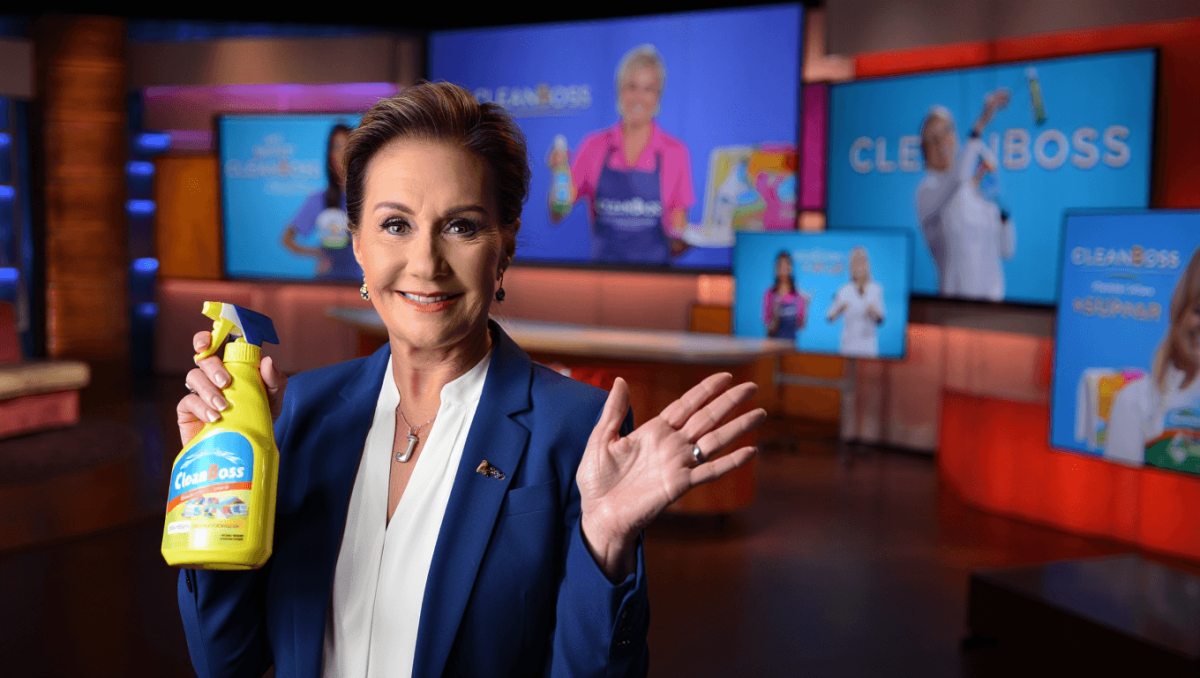
Unlike quick social videos, the brand’s TV spots are shot professionally in a studio with Mangano positioned as the hero. The ads follow a simple formula: name the problem, demonstrate the solution, and present a clear call to action.
That formula blends credibility with entertainment, letting a hands-on demo do the selling while the aesthetic taps consumer nostalgia.
Ad placements, formats and weekly cadence
CleanBoss runs a mix of spot lengths to reach broad audiences:
- 60-second and 120-second direct-response commercials.
- Occasional 30-second spots for higher-frequency buys.
- Frequent placements on cable news networks several times per week.
Rather than debuting every new product on social platforms, the company recently launched a wrinkle-release spray on linear television first. That shows how central TV remains to product rollouts.
Cost dynamics and where linear TV fits in today’s media mix
While linear TV once carried a reputation for high prices, CleanBoss finds that rates have softened. The company works with an agency that negotiates placements and pricing.
Linear CPMs can be lower than some digital options, because the medium buys broad reach rather than fine-grained audience slices. CleanBoss still invests in Meta, TikTok Shop and Amazon ads, but TV represents a sizable portion of media spend.
Why direct-response still delivers dependable returns
For CleanBoss, direct-response TV blends the scale of broadcast with measurable performance outcomes familiar from digital marketing. The team can see near-immediate sales uplifts tied to specific airings.
Chief digital officer Nevin Jethmalani credits strong product-market fit with scaling on TV. He notes that while cheesy ads have a stigma, the format is underused by brands looking to reach shoppers outside the programmatic funnel.
Operational realities: production, frequency and patience
Direct-response campaigns require higher production values than many social ads. CleanBoss films its spots in studio with Mangano leading demonstrations.
- Ads are rehearsed to highlight pain points and solutions.
- Multiple weekly spots create the frequency needed to build momentum.
- Brands should expect a runway: not every campaign converts instantly.
Consistency matters: CleanBoss treats TV as an ongoing channel, not a one-off stunt.
The role of celebrity founders and the power of a recognizable host
Mangano’s history selling live on QVC and HSN gives CleanBoss a unique advantage. Her on-screen energy and credibility connect with viewers who remember her earlier work.
That personal tie-in amplifies the nostalgic feel and makes demonstrations feel authentic. For CleanBoss, the host is more than a face; she embodies the brand promise on camera.
Where TV drives customers and how buying behavior has shifted
The company sees TV prompting searches and purchases across multiple channels. Viewers may dial the 1-800 number, click a shown URL, or buy on Amazon later the same day.
Television has become a discovery engine, nudging consumers into ecosystems where they feel most comfortable completing a purchase.